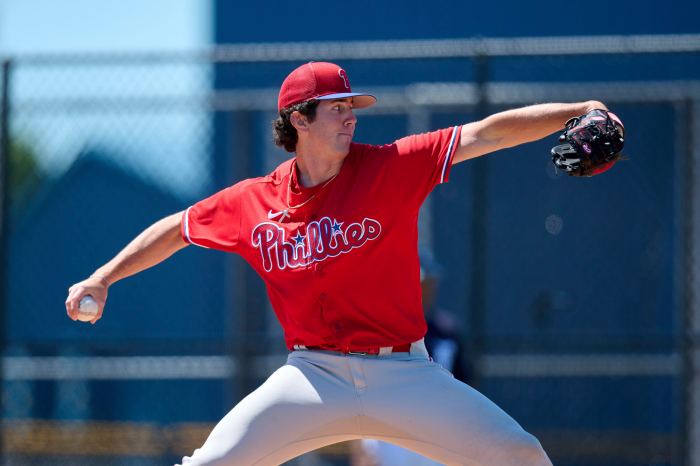
Numbed by a sport awash in data, whose stadium scoreboards instantly display metrics for thousands of ordinary at-bats and tens of thousands uneventful pitches, whose 30 teams are now steered in part by research directors and quantitative analysts, it is understandable that the average Philadelphia Phillies fan takes little note of a set of numbers that has taken the team four years to compile: $2.9M, $6.9M, $14.3M, and $50.1M.
Those rapidly escalating dollar amounts are what the Phillies will have paid from 2022 through 2025 in Competitive Balance Taxes – the penalty that MLB assesses annually to teams that surpass the salary threshold established for each season by the Collective Bargaining Agreement.
This season’s eye-popping $50-million CBT penalty has two drivers.
One is the Phillies Projected 40-Man Competitive Balance Payroll. At $309M, it races past this season’s $241M threshold by a whopping $68M, registering as the third highest CB Payroll in the National League. It is a remarkable fact of baseball economics that the Phillies 2025 salary is more than the combined team salaries of the Saint Louis Cardinals and the Milwaukee Brewers.
The other driver is the progressive tax rate tied to recidivism. Because this is the fourth consecutive season in which the Phillies will surpass the CBT threshold, and because they are surpassing multiple CBT spending tiers this season, they will be smacked with an effective 80% tax rate on their collective overages. Welcome to the adult table.
This breakneck spending spree is a notable reversal of form for an organization that had never surpassed the CBT before 2022, a parsimonious streak dating back 25 years.
Team owner John Middleton’s laudable largesse has not yet produced a parade, but in a seminal season that finds his team with a mere half-game divisional lead at the All Star break, it does produce questions about the sustainability of the Phillies payroll approach and the direction team executives will pursue at the trade deadline.
SILVER ALERT: DAVE DOMBROWSKI
Gary Sheffield. Miguel Cabrera. Chris Sale. Hall of Fame caliber talent acquired by GM Dave Dombrowski in three different decades, to bolster World Series runs by the Marlins, Tigers, and Red Sox.
Randy Johnson. Trevor Hoffmann. Elite Hall of Fame talent, traded away by GM Dave Dombrowski when both were raw, unpolished players.

That version of Dave Dombrowski, gunslinger and gambler, who can easily be imagined applauding Jordan Belfort’s excesses and grinning during The Deer Hunter Russian Roulette scenes, has not surfaced here.
Instead, since being named President of Operations in December 2020, Dombrowski’s trades have been safe and uninspired; his role in roster shaping has yielded average returns, especially given the organization’s loose purse strings.
For context, consider that all of the following foundational blocks were assembled on the watch of the oft-maligned Andy McPhail-Matt Klentak regime: the Bryce Harper signing, the initial Zack Wheeler signing, the trades for J.T. Realmuto and Cristopher Sanchez, the amateur selections and signings of Aaron Nola, Alec Bohm, Bryson Stott, and Ranger Suarez. A talented core for Dombrowski to inherit and guide across the finish line.
NO STAIRS WAY TO HEAVEN
In the spring of 2022, following the Phillies 10th straight year of missing the playoffs, Dombrowski got to work, sort of, plugging holes through aggressive spending.
Kyle Schwarber and Nick Castellanos were signed to long-term contracts that added $40M annually to payroll. Both were key contributors in the World Series and 2023 playoff runs. Schwarber has remained a slugging force, a 2025 All-Star now in his walk year.
After the euphoric World Series run, the Phillies extended Dombrowski’s contract for 5 years. He inked Trea Turner to a massive 11-year, $300M deal that winter. Taijuan Walker was signed to an inexplicable 4-year deal for $72M. The tandem added another $45M to annual payroll.
Last off-season, after the NLDS flop against the Mets, Dombrowski traded for starting pitcher Jesus Luzardo at reasonable prospect cost; the move fortified a team strength.
But when it has mattered most the last four years, with an organizational mandate to lay claim to the Commissioner’s Trophy, Dombrowski’s in-season trades and strategic off-season adds have netted Kyle Gibson, Ian Kennedy, Noah Syndergaard, Brandon Marsh (for Logan O’Hoppe), David Robertson, Craig Kimbrel, Michael Lorenzen, Austin Hays, Carlos Estevez, Rodolfo Casto, Jordan Romano, and Max Kepler.
It was retread Syndergaard on the hill for Game 5 of the World Series, opposing Justin Verlander, the AL’s Cy Young Award winner that year. It was 35-year-old Kimbrel (released by LA the previous season) imploding against the Diamondbacks, collecting crucial losses. It was playoff virgin Estevez serving up Franciso Lindor’s backbreaking slam.
Not a Matt Stairs or Joe Blanton in the pedestrian bunch.
WHAT ARE OUR PROSPECTS
The general expectation across baseball, and a source of endless fodder for Philly sports talk radio, is that the Phillies will be aggressive deal makers this trading season. Why have a $309M payroll, and more pointedly, why incur $50M in luxury tax penalties, if not to push more chips to the middle of the table? Why not give this veteran core, motivated by last season’s quick playoff ouster, their final shot at redemption? Prospects be dammed, right?
Well, maybe.
The answers to three questions should guide how the organization plays its hand.
Question One: Is it possible to address the team’s deficiencies and still not improve the team’s chances of winning the World Series?
This requires come-to-Jesus soul searching.
At the All Star break, FanGraphs calculated the Phillies to have a 9.7% chance of winning the World Series – the third best odds in MLB and a nod to the team’s SP talent and playoff experience. The unquestionable favorite is the LA Dodgers at 21.2%.
The road to an NL pennant – let alone a world championship – goes through a team with an enviable roster of star talent (active and injured) hungry for a repeat. It is backed by ownership with an appetite and track record for spending that dwarfs the Phillies: in 2025, the Dodgers are projected to have a Competitive Balance Payroll of $403M and a CBT Penalty payment of $154M.
By the time the playoffs begin, the front of the LA rotation is likely to include ace Yoshinobu Yamamoto, ace Shohei Ohtani, and 2-time Cy Young Award Winner Blake Snell. Expect the Dodgers to use their enviable farm system and surplus of MLB-ready talents like Dalton Rushing, Emmett Sheehan, and Alex Freeland to bolster their pen and upgrade an OF slot. It should surprise no one were LA to add another accomplished SP at the deadline, too.
If the Phillies do not win the NL East and earn a round-one bye by compiling the second-best record in the National League, they could square off against LA as soon as the NLDS.
Question Two: What is the team’s identity?
After the dick-swinging contest with LA has been completed, an existential question – chewed on by Jean Valjean and countless amnesiacs – awaits owner John Middleton: Who Am I?
Are the Philadelphia Phillies limitless spenders now? Does it give Middleton any pause to know that the team’s current modus operandi has the Phils on track to outspend the Brewers by $170M and yet have one fewer win at the break?
Does paying $50M in luxury taxes come with lost opportunities – dollars that could have yielded improvements if spent elsewhere – or is it just chump-change ante, the cost of a Quixotic quest?
If Middleton truly does not mind paying exorbitant luxury taxes, he is going to love 2026: the team has already committed $163M for only seven players.
And were the Phils to reach agreement with free agent Kyle Schwarber on a deal averaging $30M annually, sign JT Realmuto for $10M as a stop-gap, and pony-up modest service-time bumps to Alec Bohm and Bryson Stott, the springtime 2026 Competitive Balance Payroll would sit at $215M and account for less than half of the opening day roster!
Question Three: How will the voices in the Phillies war room be weighted?
In early July, Baseball America updated its Top 100 Prospects List; it included six Phillies, with familiar names like Andrew Painter and Aiden Miller and a breakout player, infielder Aroon Escobar. This type of representation, a mix of domestic and international players scouted, signed, and developed by Brian Barber and Preston Mattingly the last five seasons, is encouraging.
Both executives are young and talented; Mattingly has risen to a role of Assistant President and General Manager. Barber has risen to Assistant General Manager, with a focus on amateur scouting. Sam Fuld is currently earning an MBA in preparation for a 2026 role as President of Business Operations.
Have the wunderkind executives earned the right to be heard, really heard, on how aggressive the team should be at this year’s trade deadline, a team they will inherit and oversee shortly? Do they favor holding onto as much of this talented crop of kids as possible?
Does Middleton still have full faith and trust in Dombrowski to do Dombrowski things, things that brought titles to two other franchises? Does it matter at all that Dombrowski will be stepping down in two years?
PREDICTION: ALL IN
The Goliathan that is the Los Angeles Dodgers is ignored. Middleton soldiers on with spending and expresses a willingness to take on more contract dollars through trade; there really is no turning back once $50M in luxury taxes is on the ledger.
With full-throated endorsement from ownership, Dombrowski dials a recent ex, the Boston Red Sox. They hook up on an 8-player blockbuster: Alex Bregman, Jarren Duran, and Aroldis Chapman for Alec Bohm, Andrew Painter, Orion Kerkering, Mick Abel, and Justin Crawford .
Bregman adds slugging to this year’s team and can be extended through the 26-27 seasons, providing cover against the loss of Schwarber. Duran is an athletic OF under club control — a blend of pop and speed with the ability to play left and center. Chapman is a rental with deep playoff experience; at age 37, he has posted a 40% K rate this season and still averages 99 mph on his sinker.
The Sox get Philadelphia’s 1st, 4th, and 6th ranked prospects, along with Bohm — who has one year of club control remaining — and an intriguing 8th-inning arm in Kerkering. The Painter and Abel acquisitions address one of the few areas of need for Boston’s stellar farm system.
The all-in approach satisfies the Phillies fanbase. The team does not win it all. Middleton, who once turned smoke into $2.9B, is left to ponder the irony of watching $50M go up in smoke.
 Lefthand Communications